_edited.png)
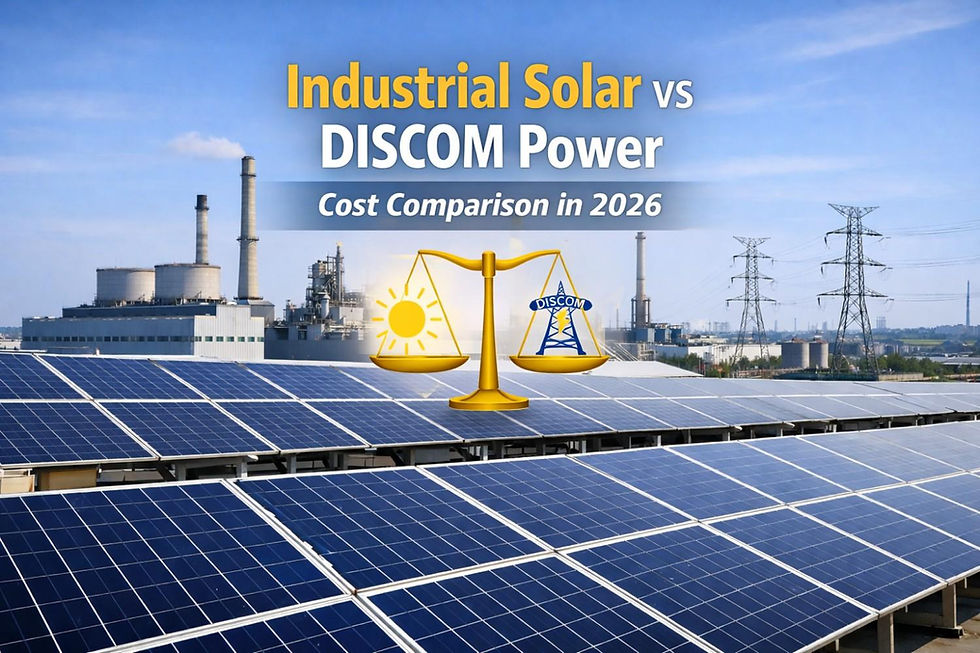
Industrial Solar vs DISCOM Power: Cost Comparison in 2026

Introduction
For factories in India, electricity has become one of the most unpredictable operating costs. DISCOM tariffs change frequently, additional charges keep appearing on bills, and power quality issues continue to affect production.
As industries plan for 2026 and beyond, many factory owners and CFOs are rethinking their energy strategy. The question is no longer just about going solar. It is about comparing industrial solar vs DISCOM power and understanding which option offers better cost control and stability.
This blog explains the real difference between the two—without technical complexity and without focusing on numbers.
How DISCOM Power Impacts Industrial Operations
DISCOM electricity has been the primary power source for industries for years. While it offers easy access, it also comes with challenges that affect long-term planning.
Industries often face:
Changing electricity tariffs
Peak demand and fixed charges
Limited control over future costs
Power quality and reliability issues
The biggest issue is uncertainty. Factories cannot predict how power costs will behave over the next few years, making budgeting and margin planning difficult.
What Industrial Solar Brings to the Table
Industrial solar works on a completely different model.
Instead of buying electricity at fluctuating rates, factories generate power on-site. This changes the way energy costs behave. Solar power provides more predictability and reduces dependency on external suppliers.
For industries that operate mainly during the day, solar aligns naturally with consumption patterns. The result is better energy utilization and improved control over operating expenses.
Industrial Solar vs DISCOM Power: Key Cost Differences
1. Cost Predictability
DISCOM power costs are revised regularly, often without warning. Industries have no control over these changes.
Industrial solar offers long-term stability. Once the system is operational, energy costs remain largely consistent. This predictability helps factories plan operations and finances with more confidence.
2. Dependency vs Control
With DISCOM power, factories depend entirely on the grid for supply, pricing, and quality.
With industrial solar, factories take partial control of their energy needs. Even when the grid remains in use, solar reduces dependency and exposure to external changes.
3. Impact on Peak Load
Peak demand charges significantly affect industrial electricity bills.
Solar generates power during daytime peak usage hours, helping reduce grid dependency during high-load periods. This directly improves overall cost efficiency and demand management.
Operational Factors That Influence Cost Comparison
The cost advantage of industrial solar does not come automatically. It depends on how well the system is planned and executed.
Important factors include:
Accurate load assessment
Proper system sizing
Shadow-free layout
Safe electrical and structural design
A well-designed solar plant delivers consistent output, while poor planning can reduce expected benefits.
Role of Execution Quality in Long-Term Savings
Execution quality plays a major role in determining whether solar truly outperforms DISCOM power.
Good execution ensures:
Reliable system performance
Fewer breakdowns
Lower maintenance issues
Longer system life
Industries benefit most when solar is treated as long-term infrastructure, not just a one-time installation.
Ownership Models and Cost Planning
Industries today can adopt solar in different ways.
Some prefer owning the system for long-term control and asset value. Others choose operating models that allow solar usage without upfront investment.
Both approaches reduce reliance on DISCOM power and help stabilize energy costs. The right choice depends on financial strategy, risk preference, and operational priorities.
Beyond Cost: Strategic Benefits of Industrial Solar
While cost comparison is important, industrial solar also delivers additional value:
Improved energy reliability
Reduced diesel generator usage
Better sustainability compliance
Stronger environmental credentials
These benefits support long-term business resilience, even if they are not immediately visible on electricity bills.
Why 2026 Is a Key Year for Re-Evaluating Power Strategy
As industries move toward higher efficiency and sustainability standards, energy planning is becoming more strategic.
Rising power demand, regulatory expectations, and cost pressures are pushing factories to rethink traditional grid dependency. Industrial solar is increasingly seen as a core part of energy planning, not just an alternative.
Factories that plan early gain better control over future operating risks.
Final Thoughts
The comparison between industrial solar and DISCOM power is not just about today’s electricity bill. It is about long-term cost control, predictability, and operational stability.
DISCOM power will continue to play a role, but complete dependence comes with uncertainty. Industrial solar gives factories a way to reduce risk and gain more control over energy costs.
When planned and executed correctly, solar becomes a reliable partner in industrial operations—supporting growth, efficiency, and stability well into the future.


Comments