_edited.png)
Energy Security for Manufacturing Units: Why Solar Matters for Risk Mitigation

In today’s volatile energy market, manufacturing units face one major operational threat: power uncertainty.
Rising electricity tariffs, unexpected outages, policy changes, and fuel price volatility directly impact production costs and delivery timelines. For manufacturing businesses, energy security is no longer optional — it is strategic.
Solar energy offers a long-term, risk-mitigated solution.
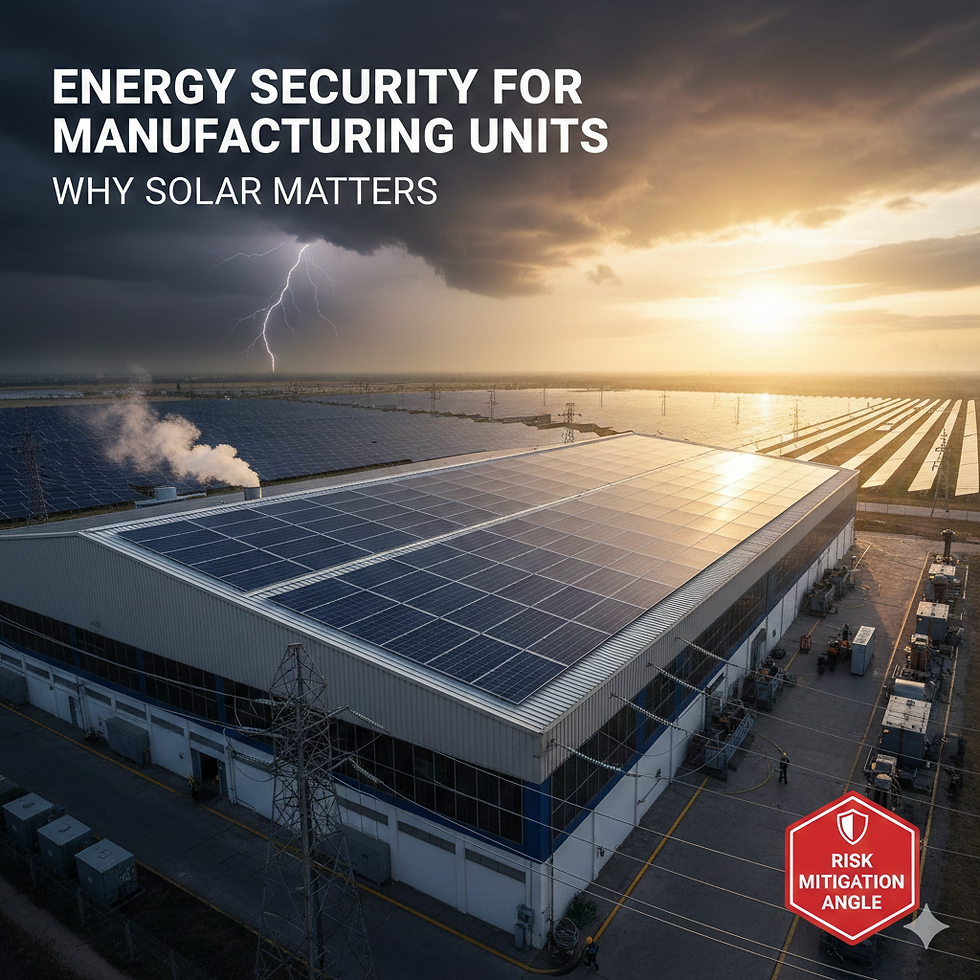
The Energy Risk Manufacturers Face
1️⃣ Grid Instability & Power Cuts
Frequent outages disrupt production cycles, damage machinery, and delay supply chains.
2️⃣ Rising Electricity Costs
Industrial tariffs increase year after year, squeezing profit margins.
3️⃣ Fuel Price Volatility
Coal and fuel-based generation costs fluctuate due to global market conditions.
4️⃣ Regulatory & Policy Changes
Energy regulations and tariff revisions can impact operational budgeting overnight.
For manufacturers operating on tight margins, these risks can significantly affect competitiveness.
How Solar Strengthens Energy Security
✔ Predictable Energy Costs
Solar provides stable, long-term electricity generation. Once installed, energy costs become highly predictable for 20–25 years.
✔ Protection Against Tariff Hikes
By generating your own power, you reduce dependency on grid-based pricing fluctuations.
✔ Reduced Operational Downtime
With hybrid or battery-integrated systems, solar supports uninterrupted production.
✔ Improved ESG & Compliance
Sustainability reporting is now critical for global supply chains. Solar improves your ESG profile and investor confidence.
✔ Higher Asset Valuation
Energy-independent facilities often have stronger long-term valuation and financial credibility.
Solar as a Strategic Risk Mitigation Tool
Solar is not just an energy solution — it is a financial hedge.
Manufacturing units that adopt solar:
Lock in lower operating costs
Improve EBITDA margins
Reduce exposure to external energy shocks
Strengthen long-term competitiveness
In a global market where cost efficiency determines survival, solar becomes a strategic advantage.
ROI Perspective for Manufacturing Units
Most industrial solar installations achieve:
ROI within 3–5 years
70–80% reduction in grid dependency
25+ years of energy generation
For energy-intensive industries, the numbers are even more compelling.
Why Now Is the Right Time
Government incentives and accelerated depreciation benefits
Increasing industrial electricity tariffs
Growing pressure from global buyers for sustainable sourcing
Delaying solar adoption means continuing exposure to unpredictable energy risks.
Conclusion
Energy security is business security.
For manufacturing units, solar power is not just about sustainability — it is about stability, profitability, and risk management.
The question is no longer “Should we invest in solar? ”It is “How much longer can we afford not to?”


Comments