_edited.png)
How Solar Reduces Dependency on Power Vendors & DG Sets

The Key to Operational Reliability for Modern Businesses
For manufacturing units and commercial facilities, power is not just a utility — it is the backbone of operations.
Yet many businesses still depend heavily on:
External power vendors
Grid supply with frequent interruptions
Diesel Generator (DG) sets during outages
This dependency creates cost instability, operational risk, and production uncertainty.
Solar power changes that equation.
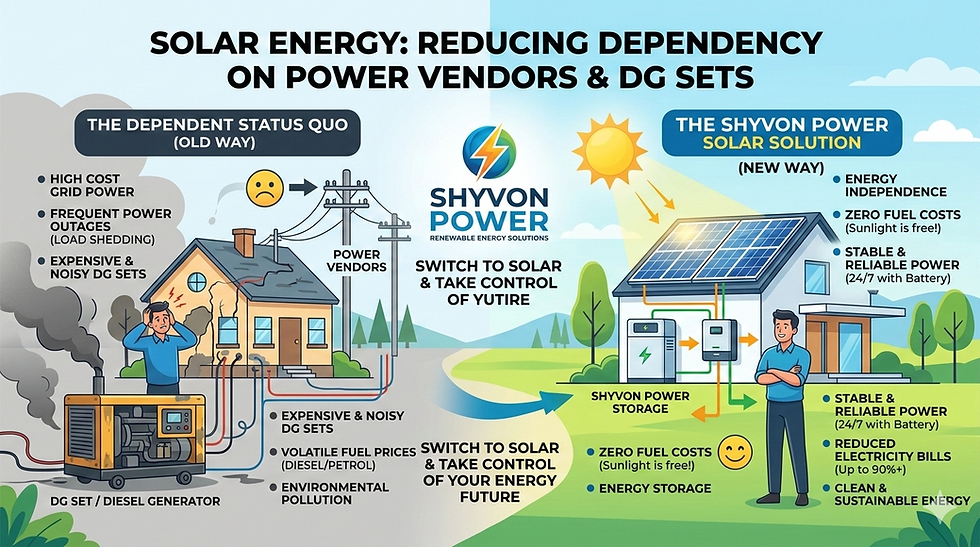
The Problem: Vendor & DG Set Dependency
1️⃣ Unpredictable Vendor Tariffs
Third-party power purchase agreements (PPAs) and open access vendors often revise rates. Over time, your energy cost advantage shrinks.
2️⃣ Diesel Generator Cost Burden
DG sets come with:
High diesel costs
Ongoing maintenance expenses
Noise & pollution compliance issues
Operational inefficiencies
Diesel-based generation can cost significantly more per unit compared to solar.
3️⃣ Operational Downtime Risks
Grid failures + delayed DG start-ups = production delays.
Even small interruptions can disrupt:
CNC machines
Process industries
Cold storage units
Automated production lines
Operational reliability becomes compromised.
How Solar Strengthens Operational Reliability
✔ Reduced Grid Dependency
Rooftop or captive solar systems generate power on-site, reducing reliance on external vendors.
✔ Lower DG Set Usage
Solar significantly reduces the need for diesel backup during peak daylight hours. With battery integration, even outage dependency decreases.
✔ Stable Daytime Production
Most manufacturing activity happens during the day — exactly when solar generation is highest.
✔ Hybrid System Advantage
Solar + Grid + Battery creates a multi-layered energy structure, improving resilience.
✔ Improved Equipment Life
Stable voltage and reduced DG switching improve machinery longevity.
Financial & Operational Benefits
Businesses adopting solar typically experience:
50–80% reduction in grid dependency
Significant drop in diesel consumption
Lower maintenance costs
Predictable long-term power costs (20–25 years)
Better ESG and sustainability compliance
Solar transforms energy from a recurring uncertainty into a controlled asset.
Strategic Advantage for Manufacturers
When you reduce dependence on vendors and DG sets, you gain:
Higher production reliability
Stronger delivery commitments
Improved cost competitiveness
Enhanced investor confidence
In competitive markets, reliability equals credibility.
Why Now Is the Right Time
Diesel prices remain volatile
Electricity tariffs continue rising
Sustainability requirements are increasing
Government incentives support industrial solar adoption
Delaying solar means continued exposure to unpredictable power risks.
Final Thought
Operational reliability is a strategic asset.
Solar power allows businesses to:
Move from reactive energy management To proactive energy control
Less dependence.
More stability.
Greater profitability.


Comments