_edited.png)
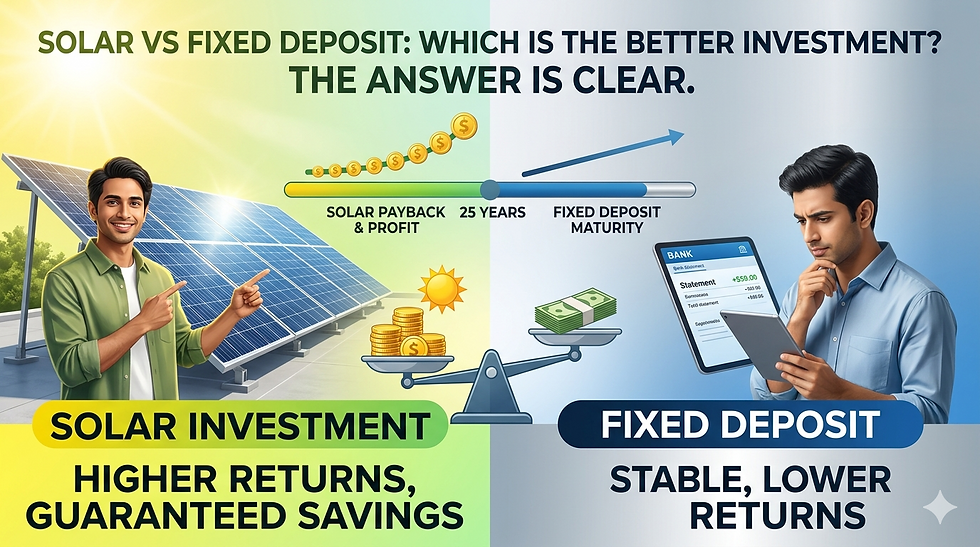
Is Solar a Better Investment Than Fixed Deposit?

Introduction
When it comes to safe investments in India, Fixed Deposits (FDs) have always been a popular choice. But with rising electricity costs and increasing awareness about renewable energy, many people are now asking:
Is solar a better investment than a fixed deposit?
The answer might surprise you.
What is a Fixed Deposit (FD)?
A Fixed Deposit is a low-risk investment offered by banks where you earn interest over a fixed period.
Key Features:
Safe and stable returns
Interest rate: 5%–7% annually (approx.)
No major risk
Returns are taxable
While FDs are secure, their returns are often limited and may not beat inflation.
What is a Solar Investment?
A solar investment means installing a solar power system at your home, factory, or business.
Instead of earning interest, you save money on electricity bills every month, which acts like a return on investment.
Solar vs Fixed Deposit: Quick Comparison
Factor | Fixed Deposit | Solar Investment |
Returns | 5%–7% yearly | 15%–25% savings ROI |
Risk | Very low | Low (with proper installation) |
Tax | Interest taxable | Savings are tax-free |
Duration | Fixed | 25+ years system life |
Monthly Benefit | No | Yes (bill savings) |
Inflation Impact | High | Low |
Why Solar Can Be a Better Investment
1. Higher Returns
Solar systems often give 15%–25% effective returns, much higher than FDs.
2. Monthly Savings
Unlike FDs that pay interest periodically, solar starts saving money from day one.
3. Long-Term Benefits
A solar system lasts 20–25 years, giving continuous savings after payback (usually 3–5 years).
4. Protection from Rising Electricity Prices
Electricity tariffs increase every year. Solar protects you from these rising costs.
5. Government Support
Schemes like subsidies and benefits reduce the initial cost, improving overall returns.
Example Calculation
Let’s compare ₹5 lakh investment:
Fixed Deposit:
Interest: ~6%
Annual return: ₹30,000
Tax reduces actual earnings
Solar System:
Annual savings: ₹75,000–₹1,00,000
Payback: ~4–5 years
After that: almost free electricity
Clearly, solar offers better long-term value.
When FD Might Still Be Better
To be fair, FDs may suit you if:
You want short-term liquidity
You cannot install solar (no roof space)
You prefer zero involvement
But for most homeowners and businesses, solar provides stronger financial benefits.
Who Should Choose Solar?
Solar is ideal for:
Factory owners with high electricity bills
Small businesses and warehouses
Homeowners with rooftop space
Farmers using electric or diesel pumps
Final Thought
Fixed Deposits are safe—but limited.
Solar is not just an expense, it’s an asset that generates savings every month. With higher returns, long-term benefits, and protection against rising costs, solar is quickly becoming one of the smartest investments in India.
If you’re thinking long-term, solar clearly has the edge over FDs.


Comments