_edited.png)
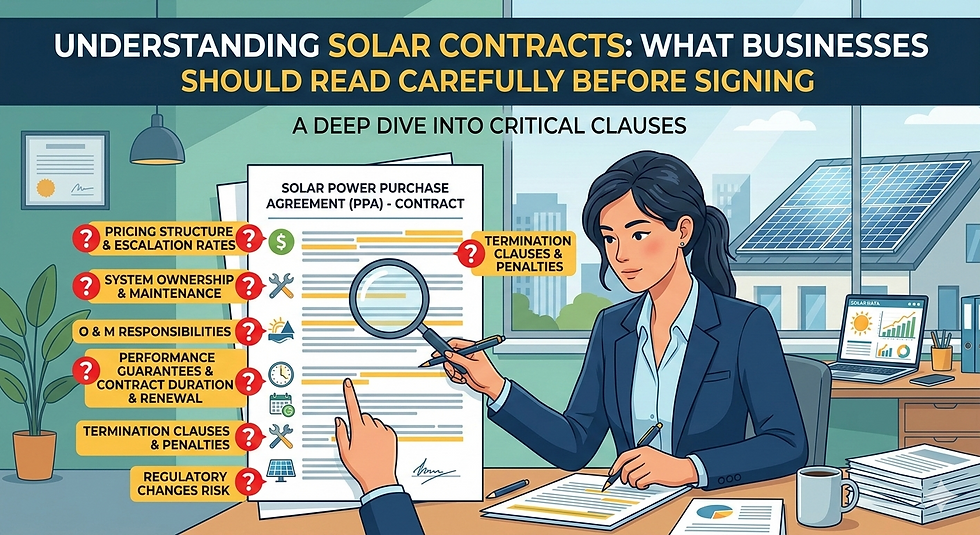
Understanding Solar Contracts: What Businesses Should Read Carefully Before Signing

Solar installation is a 20–25 year commitment.
For factories, commercial buildings, and large businesses, it is not just an energy decision — it is a legal and financial agreement that impacts long-term profitability.
While most businesses focus on price per kW, the real risk lies in the contract details.
Before signing any solar agreement, here is what every business must carefully review.
Why Solar Contracts Matter More Than You Think
A solar system will:
Supply power for decades
Influence operating costs
Affect compliance and regulatory standing
Impact cash flow and ROI
One unclear clause today can reduce savings tomorrow.
That is why contract clarity equals financial security.
Key Solar Contract Clauses Businesses Must Review
1️⃣ Ownership Structure: CAPEX or OPEX?
First, understand the model:
CAPEX Model
You invest upfront
You own the solar asset
You claim depreciation benefits
OPEX / PPA Model
Developer owns the plant
You pay per unit of electricity
Long-term power purchase agreement (PPA)
Check clearly:
Who owns the system?
Who handles insurance?
Who benefits from tax advantages?
Ownership confusion leads to future disputes.
2️⃣ Performance Guarantee & Generation Commitment
This is one of the most important sections.
The contract should clearly state:
Minimum annual energy generation
Performance ratio guarantees
Compensation if generation falls short
If there is no written performance commitment, the risk shifts to you.
3️⃣ Tariff Structure & Escalation Clause (For PPA Agreements)
Some agreements include:
Fixed tariff for 20–25 years
Annual escalation (e.g., 2–3%)
Even a small yearly escalation significantly impacts total cost over 25 years.
Always calculate long-term financial impact before signing.
4️⃣ Operation & Maintenance (O&M) Responsibility
Clarify:
Who performs maintenance?
Response time for breakdowns?
Panel cleaning schedule?
Inverter replacement terms?
Operational reliability depends on strong service level agreements (SLA).
5️⃣ Exit Clause & Early Termination Conditions
Businesses evolve.
Your contract must answer:
What if you relocate the factory?
What if expansion changes rooftop structure?
What if the developer fails to deliver?
What are early exit penalties?
Flexibility protects your business.
6️⃣ Regulatory & Net Metering Compliance
In India, solar systems must align with:
DISCOM regulations
Net metering policies
Open access guidelines
Ensure the agreement clearly states:
Who is responsible for approvals?
What happens if policies change?
Regulatory clarity prevents operational disruptions.
7️⃣ Insurance & Risk Coverage
Solar plants must be insured against:
Fire
Theft
Natural disasters
Electrical faults
Confirm:
Who bears liability?
Who pays insurance premiums?
What is covered?
Risk transfer should be clearly documented.
8️⃣ Hidden Charges & Additional Costs
Review carefully for:
Monitoring fees
Synchronization charges
Grid connectivity costs
Demand charge implications
Transparent cost structure builds trust.
Common Red Flags in Solar Agreements
Verbal promises not written in contract
No generation guarantee
Unclear maintenance responsibility
No clarity on tariff escalation
Weak exit clause
If it is not written clearly, it is not legally enforceable.
Why Careful Contract Review Builds Long-Term Trust
Solar is not just about panels.
It is about:
Financial predictability
Legal protection
Operational reliability
Risk mitigation
A transparent contract protects your savings for 25 years.
The right solar partner will:
✔ Explain every clause clearly
✔ Provide written commitments
✔ Share performance projections
✔ Offer long-term service assurance
Trust begins with documentation.
Final Thought
Solar is a strategic business decision.
Before signing any agreement, review the contract carefully — or consult a legal and financial advisor.
Because a 25-year investment deserves 25 minutes of careful reading.


Comments